
Seeing the Forest Through its Trees —Part V: Balsam Fir


By Larry Ely
Balsam Fir, according to the Maine Forest Service, is the most abundant tree in Maine though more prevalent in northern counties. It is the traditional and most popular choice for a Christmas tree in our region because of its full shape and strong scent.
Far from lamenting its use as a short-lived Christmas tree, Donald Culross Peattie wrote “… far better that the little tree should arrive, like a shining child at your door, breathing of all out of doors and cupping healthy North Woods cold between its boughs…” For many, balsam fir evokes the tradition of the season.
Its main commercial use is as pulp and for paper making, while its light and soft wood is also used for light building construction. Branch tips are also clipped to make wreaths and to fill balsam pillows and sachets.
Balsam fir’s “evergreen advantage” lets it photosynthesize year-round in cold mountain forests.
Balsam fir (Abies balsamea) and various spruce species usually dominate sites in cold hollows, stream channels, and the mountain slopes of our Mahoosuc Mountains. Those sites, especially within the high elevation forests, allow fir to dominate with its “Evergreen Advantage” - the ability to retain needles (leaves) year-round. That allows continued photosynthesis throughout the year without the energy-draining necessity to reproduce foliage in the spring.
Balsam fir sites are generally nutrient poor with organic material slow to break down, allowing the fir with its low nutrient requirements to outcompete most other species. It is also cold hardy, withstanding temperatures as low as -80 degrees Fahrenheit. That cold adaptation also means that it is reaching the limits of its southern range in our forests.
The tree is very shade tolerant and capable of surviving and able to reproduce under the shade of dense forests and in thick organic matter. Fir blowdowns are slow to decay and make for a difficult off-trail bushwhack.
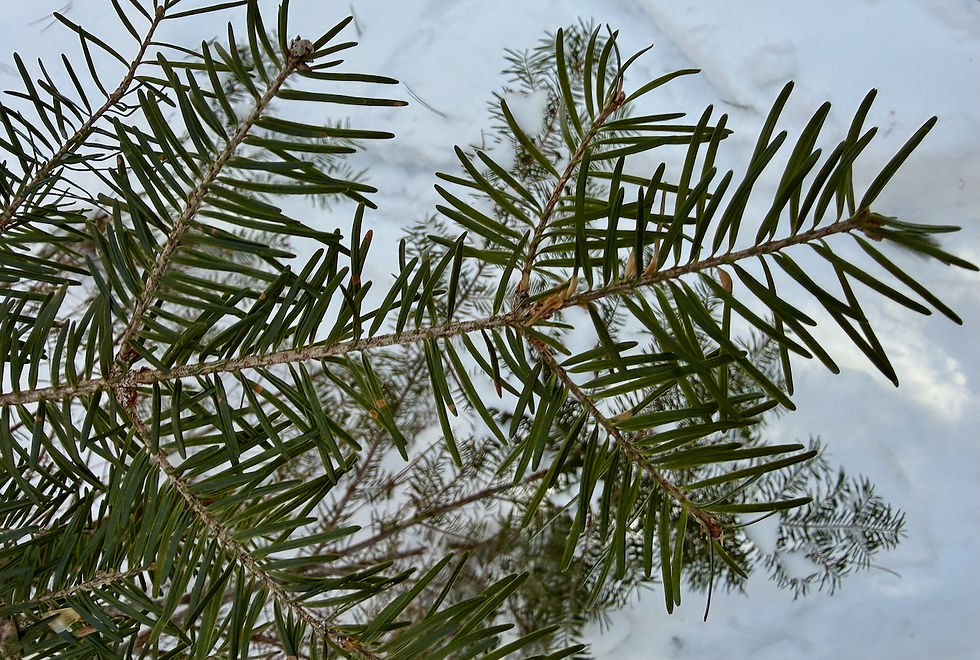
Balsam Fir can be identified by its flat needles which are dark green on top and paler on the underside with a few white lines. Each needle ranges from just over half an inch long to slightly over an inch. The look-alike spruce has sharply pointed and prickly needles that grow along the twig. The smooth gray bark of fir is also distinctive with its many resin blisters, though the bark becomes rough and fissured on older trees. The blisters can be used as a natural fire starter, one reason that firs may flare during forest fires.

Balsam fir is not long-lived, typically showing signs of old age at 70 years, and may reach heights of 60 to 70 feet with diameters of 12 to 20 inches. As the tree matures, its top distinctly begins to resemble a pointed spire.
Unlike other conifers in our region, the seed cones of balsam remain erect within the upper branches and form as the tree reaches 20 to 30 years of age. Those cones also do not drop like other species in the Pine Family but release seeds as cones disintegrate on the branch. Their seeds are a vital food source for the many bird species that require spruce-fir forest habitat, and the dense winter cover is critical for moose and deer winter survival. Other species that rely on balsam fir include red squirrels, mice, voles, porcupines and snowshoe hare.
While balsams are normally found in dense stands at higher latitudes and elevation, backcountry skiers following a boggy wetland channel through Mahoosuc Land Trust’s Shelburne Riverlands can find individual tall balsam firs as they near the Maine border.


Comments