
Seeing the Forest Through its Trees Part III: Eastern White Pine
By Larry Ely

Maine is widely known as the “Pine Tree State,” but our Eastern white pine (Pinus strobus) has often been labeled by historians as the "Tree That Built America.” In pre-colonial days, it was the dominant tree over most of the New England landscape, often in dense and nearly pure stands. Giants as old as 400 years with diameters of five to six feet could reach heights of 240 feet. While white pine grows best in fertile, well-drained soils, it also does well on poor sandy soils, which our glaciated mountain valleys have in abundance.
These giant pines were quickly felled by colonists to clear land for agriculture and for shipment to England and Europe where forests had long been cleared. Wood from the white pine was soft and close-grained and, while very light, was also strong in relation to its weight, perfect for furniture and log cabin building.

In 1691, King George III declared that all pines over 24 inches in diameter in the colonies were to be reserved for use as masts for the Royal Navy. The trees were marked with the King’s Broad Arrow by the Mast Agent and transported downriver for shipment to England. In 1961, Ben Werner found a Broad Arrow mark on a white pine at his Crow Mountain Farm in Shelburne near the 1800s farmhouse. Sadly, when that pine eventually fell, Ben was unable to salvage the King’s mark.
While most of these giant white pines were gone by the mid-1800s, at abandoned farms in New England white pines were among the first to fill sunny and open former pastures. The heavier, drought-resistant pine seeds were more successful than hardwoods in germinating in pasture grasses. Though the pine seedlings require nearly five years to reach a height of one foot, their growth then increases greatly to a foot or more per year. The age of young trees can be determined by the spacing of the whorls of multiple branches around the main stem, each of which denotes a single growing season.
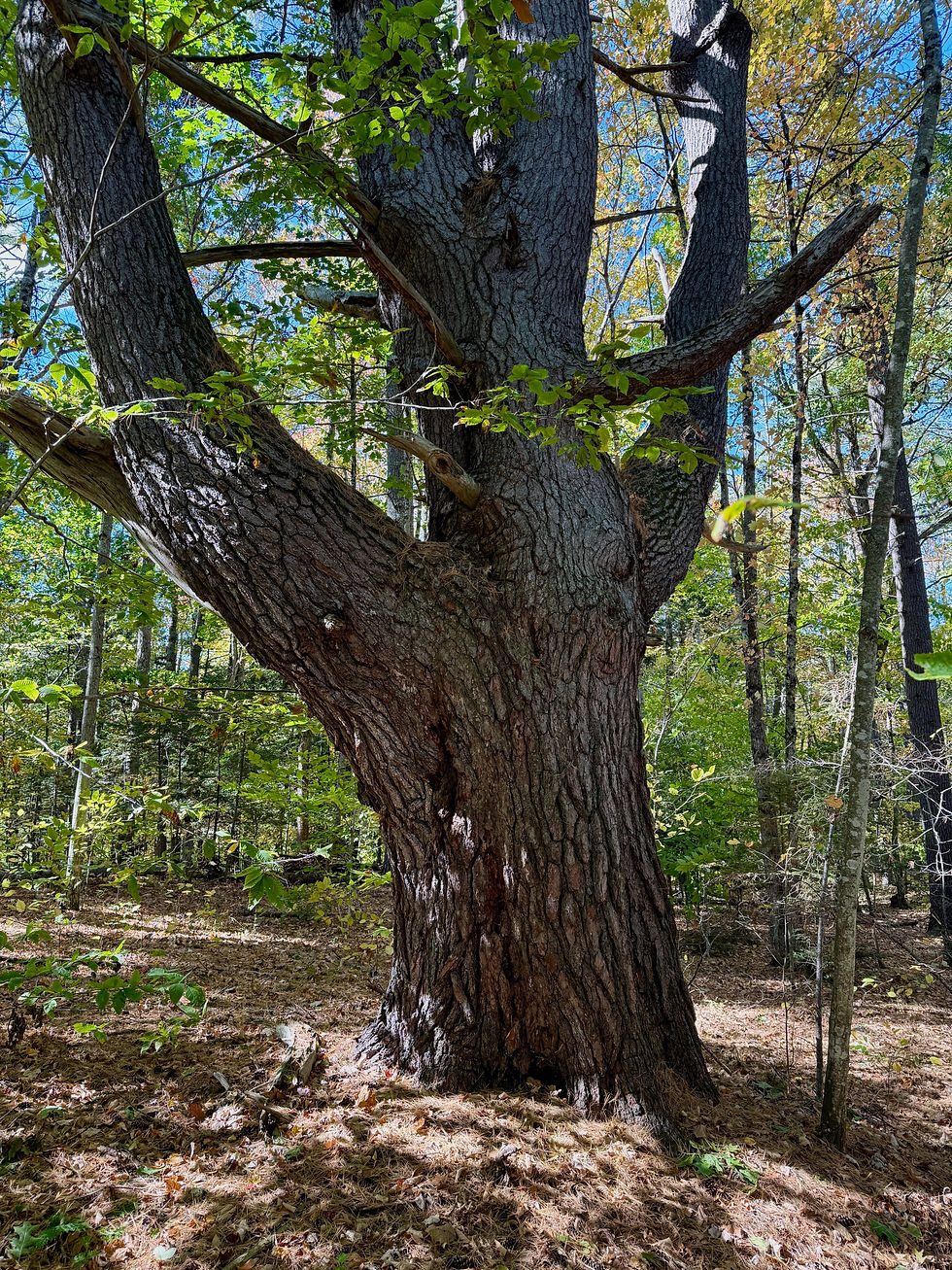
The bark of young trees remains smooth and grayish-green until the tree matures, at which time the bark darkens and develops fine fissures. In mature, older trees the bark becomes even darker with thick deep furrows. The four-to-eight-inch cones, usually with a sticky resin, don’t mature until the tree is twenty to thirty years old. Then cones are released in the fall after two years of development. White pine is easily distinguished from red pine by its bundle of five needles in comparison to the red pine’s two. While both pines appear to retain their needles, three-to-four-year-old needles die and are cast away and replaced. Large pines are favorite nesting sites for hawks and owls as well as bald eagles, and many songbirds and small mammals forage on the seeds.
The white pine in our forest today is no longer the dominant tree but is now usually found widely scattered in hardwood forests along with hemlock and other softwoods because of earlier colonial practices. A large white pine missed by the second cut in the 1900s might occasionally be encountered, but the fast-growing pines seen today are rarely over 100 years old or exceed 100 feet in height.


Comments