
Musings on Garden Pests
Part I What are “Pests”?
By John Reilly
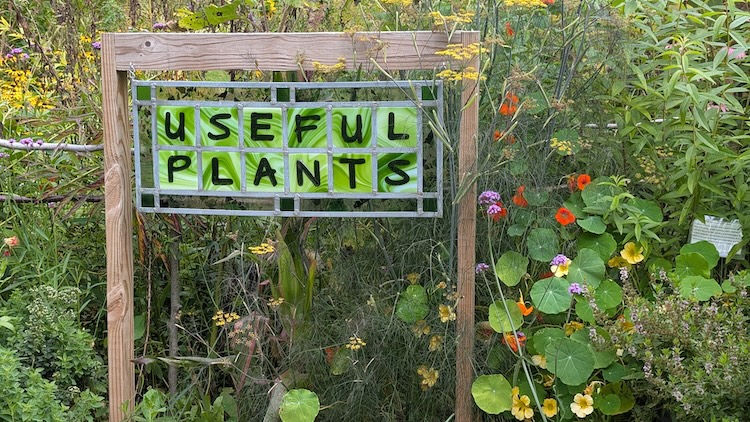
At one of our Monarch Festivals a couple of years ago, I was assigned to the “Useful Plants” area of the Habitat For All Garden. One of the most interesting questions I fielded (oh, that could be a pun and I’m going to leave it in) was, “Aren’t all plants useful?”
I tried to think quickly, to justify why we used the title “Useful Plants.” Our first instinct had been to call the section “Herbs,” maybe “Culinary and Medicinal,” but then some of the plants here were used for dyes, fragrance … and the term “herbs” sometimes applies to all herbaceous annuals and perennials. In the end, we settled on “Useful Plants.” But even then we had to admit it’s not a comprehensive collection. There is no wheat, corn, or rice, and various useful plants can also be found in the veggie section of the garden. Then, as a climate scientist myself, I know that all plants are useful parts of the carbon cycle, as well as the hydrological cycle, and in important ways help control our climate.
Squirming a bit by this time and looking for an out (Where was Mike Murphy, our head gardener, when I needed him), I said, “Well, you are right.” I paused a beat, “But maybe not poison ivy?” The couple of fellows were satisfied enough, I guess, or maybe they concluded that I was hopeless, and they moved on.
They all have their role in an ecosystem somewhere, don’t they? And it’s only when they get in our way that we call them pests.
Reading somewhere since then, I came across a discussion that upon reflection is obvious. Poison ivy has an important role to play in an ecosystem, providing food and shelter for insects and birds. (And if we are smart enough to recognize it, the defenses it has keep us away.) At least I said ‘maybe’ poison ivy was not useful.
What are pests? Speaking from the perspective of agriculture, pests include weeds, insects, animals, fungi, and plant diseases that crowd out and compete with, consume, infect, or kill our crops. We have an arsenal of methods, products, tools, techniques, and chemicals (contrived, and “natural”, or “organic”) that we can call on to do battle with pests. A little more poetic, and sympathetic, is one definition of a weed: A plant growing where you don’t want it!
This could apply to insects, animals, fungi and all organisms. They all have their role in an ecosystem somewhere, don’t they? And it’s only when they get in our way that we call them pests.
But “pest” may be broader. Is it all about us, Homo sapiens? Might we call something a “pest” that is overrunning a “natural” ecosystem, creating widespread destruction and death? For example, the western spruce budworm has exploded in western North America. It’s a native, but at this point even those not concerned about the impact on harvestable wood would call it an out-of-control pest. Mother Nature often has a way of bringing things back into balance somehow (at least temporarily), but maybe not always in ways we might think are great from our human-centered focus. Sometimes the pests become prey as predator populations take advantage of a pest’s expansion. Sometimes resources are all consumed, and the pest population dies out (mostly). And sometimes it just takes over.
Maybe “pest” is just a relative term.
Next time:
What about invasive and introduced species?


Comments